-
Forget about popularity, forget about people wanting me to win. If I said, ‘Put up your own money—bet wrong, and you lose half your net worth,’ how many people would actually bet on me? I get it.
-
// Chapter 1
-
"If I don't give this everything I've got, I shouldn't even be in the competitive scene anymore."
-
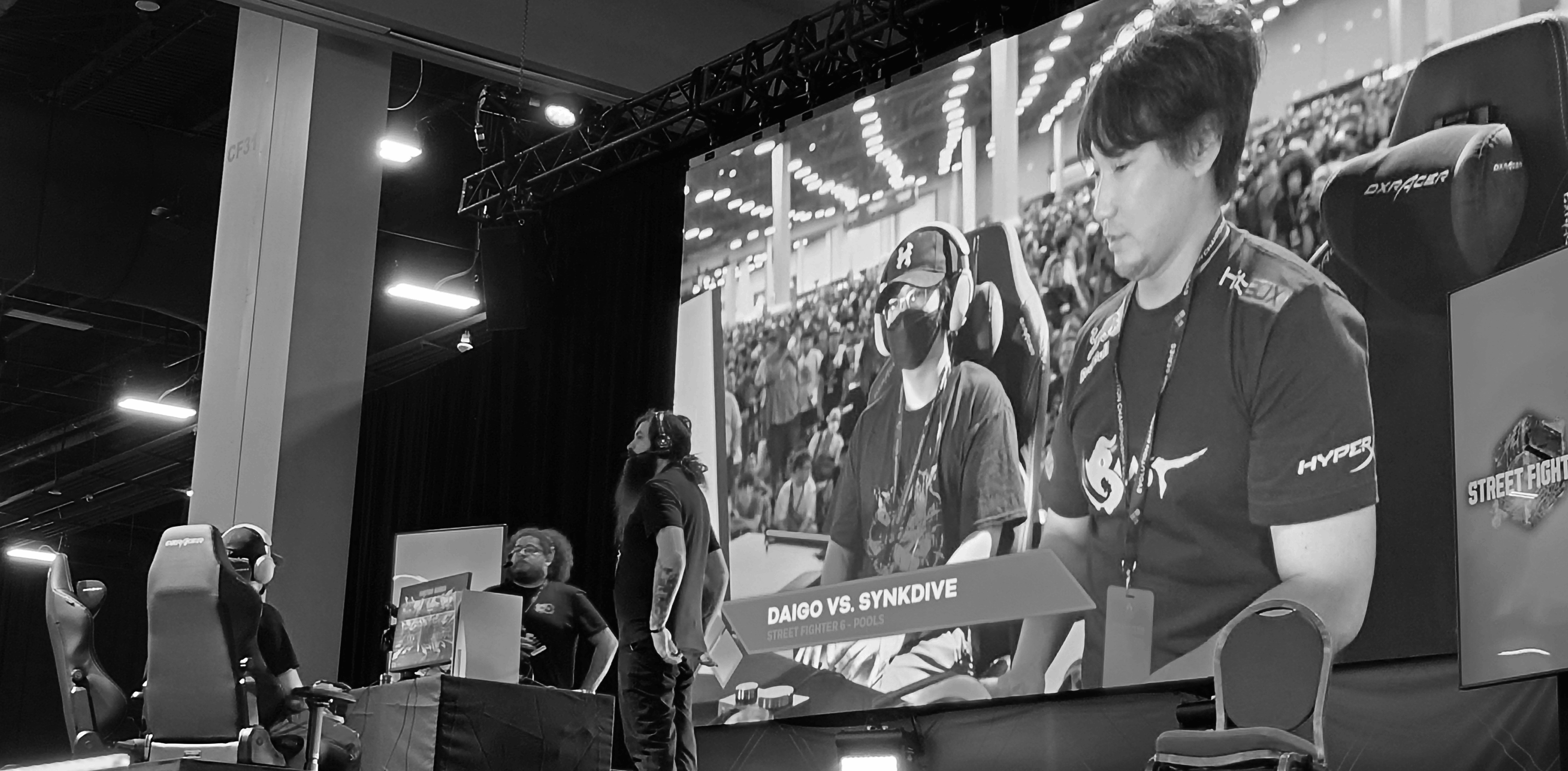
Thirty years have passed since the establishment of a new form of play known as the “fighting game.” Daigo Umehara’s career as a player traces the history of the genre. For decades, he has continually adapted to a dramatically changing landscape, keeping up fight at the forefront of the scene. Now, he gears up for a match that could prove a watershed moment in his career.
One could hardly say Umehara has had a glowing track record in the current title, Street Fighter 6. He’ll be 45 next month, marking sixteen years since the start of his life as a pro gamer in 2010. The current pro scene is what defines the new era, which means the arcade scene where Umehara spent his adolescence is a bygone one. The star players of the new generation are pushing out the old guard, and the torch is being passed. Such is the inexorable nature of the competitive world.
“I think I’m well prepared for this. I’m already in the zone.”
The zone he refers to is a heightened and refined state he has entered for countless major matchups in the past. Most of each day is spent tirelessly playing matches. Focus trumps stress. He loses all interest in the joy of food and drink—he barely even has an appetite. Some part of his mind is always alert. He notices each minor change in his midst, things to which he would ordinarily pay no mind. To give an analogy, it’s a state where he can “taste water.”
“This is probably the most in the zone I’ve been since CvS2. Of course, not quite to that extreme.”
He means the Capcom vs. SNK 2: Mark of the Millennium 2001 national tournament held in Japan in 2001. 25 years have already gone by. Umehara, then just 20 years old, went into that tournament dead set on winning, whatever it took. He was obviously in an unbalanced mental state, and he became so overly focused that his stomach eventually stopped even accepting food. In the end, he was eliminated in finals. The experience served as the catalyst for Umehara to rethink his approach to the game. With many more years of experience under his belt, there’s probably no need to worry about such an imbalance occurring anymore, but the anecdote does speak to his purity of mind when it comes to competition.
“Oh, it’s been a real reminder of the significance of doing what you love. I mean, I’m still the same person doing the same things, and yet the results are totally different—the ideas I come up with, the way I play.”
Umehara says it’s been making his heretofore approach look “tepid.” New ideas and tasks spring to mind in such rapid succession that he’s forced to drastically rethink the strategies he’s employed to date. Still, it’s not as though he wasn’t taking the game seriously before, so what exactly changed?
“Well, I think it’s that I know this match will leave no room for doubt. We have a proper prep period, and the conditions are the same for both of us. Y’know, it’s like, if you lose this one, you have no excuse.”
No excuses apply here. His confidence to push and be pushed to such lengths speaks to the depth of his dedication to the event. It’s safe to say Umehara genuinely does have his back to a wall, just as he has been known to in past moments of glory.
“So, on the flipside, I feel like if I don’t give this everything I’ve got, I shouldn’t even be in the competitive scene anymore. Ever since we decided to do this fight, my training has made me realize, ‘Oh man, this is the kind of thing I used to do back in the day.’ That’s my feeling, anyway.”
His remark that he “shouldn’t even be in the competitive scene anymore” is surely a direct reflection of how he would handle defeat, but despite the weight of his words, I don’t detect much strain or emotion in his voice. There’s no question Umehara sees this event as an extension of past headliner matchups versus the likes of Infiltration at Mad Catz Unveiled Japan and Tokido in Kemonomichi #2, to name a couple. His current foray into the zone is proof of that. And yet, something seems different. Is it his demeanor? In the past, he has always exuded an uncontainable vigor in the days leading up to a big fight, as if to say, “There’s no way I’m gonna lose this.” Now, with little time left before the match, he comes off somehow reserved. What does this signify? Interpretations may vary, but this difference in mood may hold an important window into his mindset.
vs Infiltration (MAD CATZ UNVEILED JAPAN)
vs Tokido (獣道2 / Kemonomichi #2)
-
// Chapter 2
-
"If I'm being brutally honest, I was just coasting on inertia after 18."
-
From the nineties to the aughts, arcades were the frontline of the Japanese fighting game scene. Suffice it to say that there were different dynamics in play than in the current online age. In that bygone era, Umehara’s standout prowess placed him at the epicenter of the 2D fighting game scene.
“Well, simply put, it was about fame—I wanted people in that world to know my name. I had it in my head that that would lead to something good. When you’re a kid, you just don’t know what could lead where, and I’m the type of guy who finds that unknown element highly appealing. Back then, I was still excited by the question of what might happen if I got really, really good at the game, and I just wanted to get myself to that level.”
In the past—particularly in the 90s—the sport-like aspects of fighting games were much less ironed out than they are in our current online era. Just like the idea of who’s “toughest in a fight” or “fastest on the road,” in the pre-esports era, fighting games had a certain nebulous quality to them.
“It was exciting to imagine what it would be like to have a bunch of fellow competitive guys bowing at your feet.”
By modern standards, the bar for skill may have been a bit lacking, but everyone at the arcades faced off with a brazen determination to win. Had there not been such intense butting of heads and clashing of emotions, Umehara probably wouldn’t have become so obsessed in the first place. Objective standards were much less well defined in those days, but the fastest way to prove oneself was to win a national tournament.
“Those events motivated me. But looking back, I think I started to lose that sense of wonderment around the time I won the [Street Fighter] Alpha 3 nationals. That was where I stopped getting excited about how things might turn out. So, by around just 17 or 18, I’d already lost that [motivation]. If I’m being brutally honest, I was just coasting on inertia after 18.”
1998’s Street Fighter Alpha 3 World Championship was an unprecedented event, even receiving a TV broadcast. Arguably a symbol of the entire fighting game boom of the nineties that had begun with Street Fighter II, the event culminated in Umehara’s victory. It had been such a grandiose celebration of the genre that it seemed unlikely to ever be surpassed. And sure enough, the tournament would serve as the turning point after which 2D fighting games would gradually lose their steam. With high school graduation also on the horizon, it might have been time for Umehara to cut his losses.
“I just kind of kept playing, though. I mean, even if it was just inertia, I was still playing with such abnormal frequency that no one else could tell. Like with the CvS2 (Capcom vs. SNK 2: Mark of the Millennium 2001) nationals, I really went overboard. The issue was more about how I felt on the inside. I’d already seen the end of the road once, so when I started a new game, it was like, ‘I know where this road leads,’ as opposed to, ‘I wonder what view awaits at the peak!’ The difference is night and day. That definitely marked a major shift for me. I think it was just inevitable. That’s just my own personal perspective, though.”
Umehara is, by nature, someone with an abnormally high aversion to repetition and routine. The blow this dealt to his motivation and sense of purpose must have been severe. And yet, from the outside, his obsession with fighting games only appeared to deepen. Many who knew him at the time would likely agree. Maybe it was a desperate attempt to fill the void.
Then came a moment in the mid-aughts when Umehara suddenly distanced himself from fighting games. He turned heel on his prior dedication and became detached. If this shift were driven by an “all or nothing” mentality, it would come as no surprise. But an exciting new era was coming for the inertia-driven Umehara—one that promised to let him glimpse a “new view” once again.
“It was when I went pro [in 2010] that I finally started to feel something akin to how I’d felt in the Alpha 3 days again.”
Umehara took the path of the pro gamer. About 12 years had passed since the release of Street Fighter Alpha 3. A new unknown horizon awaited, and the mystery reignited his flame. Even to an outside observer, his enthusiasm was abnormal. Since the latest version of the game, Super Street Fighter IV, was only available for home consoles, he stayed at the home of an old acquaintance, completely immersed in online matches. Often, he would play until sunrise. Finally, when all worthy opponents had logged off in the early morning hours, he would go to sleep, then wake up in the early afternoon to grind out techniques and lab out strategies in Training Mode. When evening fell, it was straight back to online matches…
After months of this full-immersion lifestyle, he began to experience physical symptoms. His face would go numb or twitch endlessly. Only then did he finally revise his approach.
“You go pro having no idea how things will play out. I feel like that unknown element and the anxiety it produces are important factors for keeping people motivated. As you become more stable as a pro player, inevitably those factors wear thin. There’s no avoiding it. I’ve never seen someone for whom that wasn’t the case. Maybe they don’t wear thin if you don’t have any sense of security, but for anyone who does, anyone who’s attained some level of status, so far that’s been the case 100% of the time.”
The trade-off for stability is the loss of unrest and wonder for the unknown. But that stability is also one of life’s goals, so maybe it is inevitable. One way of looking at it is that people let themselves lose their edge because they want to. Surely even Umehara would agree a safe and sound existence isn’t without its merits. But it does give way to stagnation, and no one can avoid it.
“I mean, I still love the actual act of playing matches. It’s just that when you’ve been doing it for over 30 years, there’s no way it’s going to stay fresh—it becomes routine. But these pre-arranged, first-to-ten challenges are what have kept me feeling a sense of danger and excitement even when the day-to-day wears thin.”
-
-


|