-
Forget about popularity, forget about people wanting me to win. If I said, ‘Put up your own money—bet wrong, and you lose half your net worth,’ how many people would actually bet on me? I get it.
-
// Chapter 3
-
"You can't just will it—human will doesn't have that power."
-
The level of polish and comprehensiveness of Street Fighter 6’s offering is astounding. The player pool has grown by an order of magnitude. You’ll have no trouble finding opponents matching your skill level. Strategies and tips for improvement are circulated across the internet, no stone left unturned. And like it or not, the ranking system provides a clear visual representation of your standing within the game. Tournaments abound, be they official or local. The thriving Capcom Pro Tour circuit has become a true entertainment enterprise, with a viewership only getting bigger year over year. The competition is fiercer than ever. One overwhelmingly massive battlefield that brings together sports and entertainment—this is the current state of the gaming scene where Umehara has long waged his battles.
“I think those who’ve seen me at work would agree that I put in the effort when it comes to tournaments. But [FT10s] are different. I even generate ideas differently. For example, I stop thinking in terms of how to deal with each specific situation. Automatically, I start thinking in terms of a single, continuous path.”
For a pro player, the primary battlefield is surely the official tournaments of the Capcom Pro Tour circuit. Umehara doesn’t take these lightly, but evidently the nature of engagement is completely different here, to the point that it even affects how he thinks about the game. To Umehara, such is the significance of an FT10.
“It’s hard to believe a person could change this much, and I’m talking about myself here. It’s been a reminder that this is the way I love to play these games. If that reminder is the only thing I get out of this, I’m still really glad I’m doing it. I guess I just need that sense of danger, that thrill, to fully commit myself anymore.”
Umehara spends his days in quiet preparation for the big day with Mena. But what exactly does it mean to “fully commit”? In short, to leave no options off the table.
“I always get like this when gearing up for a pre-arranged FT10. All that matters to me is winning, when it comes to this format. So obviously I don’t let people see me play, and anything is on the table, gimmicky or not. I get like this because when it comes to this type of set, I don’t tolerate defeat. When I was a kid, I saw the official national tournaments that way. The fact that I say that in the past tense is probably because I was still young when I won one.”
As a boy, Umehara was the type of player who only cared about winning. At 45, glimpses of that nature still show when he’s faced with the extreme conditions of an FT10 set. It’s almost like having a reunion with his younger self. But, he says, that shift in nature isn’t something he could ever effect of his own volition.
“Resolve isn’t a matter of feelings, but circumstance. You can’t just will it—human will doesn’t have that power. When I’m getting ready for an FT10, I’m reminded of how seriously I used to take this back in the day. ‘Oh yeah, this is is what it’s supposed to feel like. This is how I used to feel. I’d nearly forgotten’… As much as I want to do these FT10 sets, part of me is also content not to if I don’t have to. I’m doing this because I have to. And yet, deep down at my core, I yearn for it. It’s a bit of a contradiction.”
Umehara has been on safe footing for quite some time now, but he’s aware that there are some things he can’t experience from inside his comfort zone. It’s not only about those razor’s-edge wins and comebacks; he even finds himself longing for the taste of defeat. Everything has faded. At this point, restoring the intensity to a diluted life isn’t something he can do of his own will. Only circumstance can produce the resolve required to reclaim that intensity.
“I didn’t think I had this in me anymore. And now I find that nothing’s changed. I’m so grateful to be feeling this feeling again.”
-
// Chapter 4
-
"He was like, ‘Well, this is my responsibility.’ How cool is that?"
-
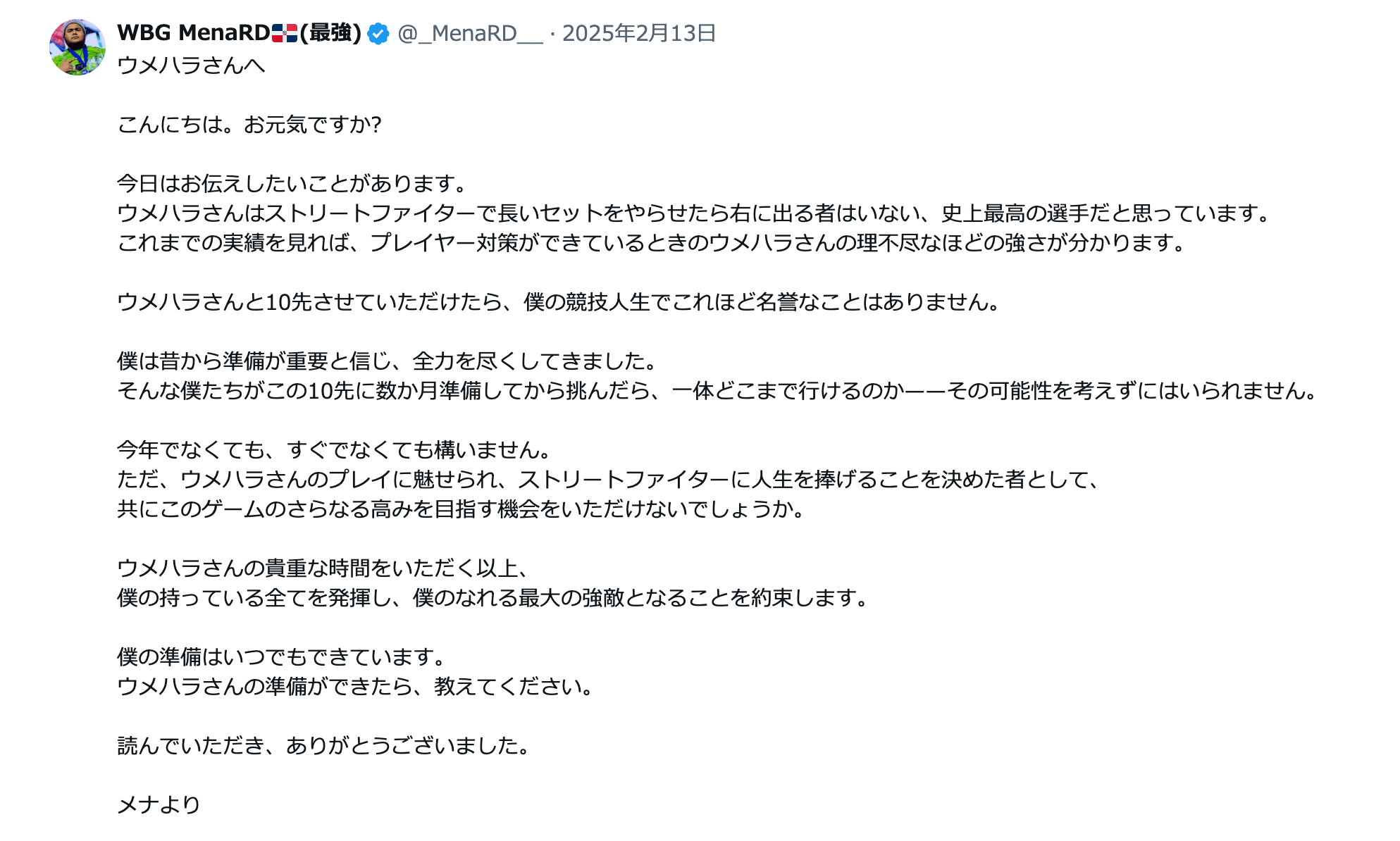
Now let’s address his opponent, MenaRD. The April 29th showdown is right around the corner, but its origin dates to February 2025, when Mena himself issued a challenge to Umehara over social media. It was an undeniably sudden call to action for Umehara.
Mena is the only person to have won Capcom Cup multiple times and is universally recognized as one of the top pro players. He issued the glove-slap to Umehara, who, despite his renown, hasn’t achieved much in the competitive scene in recent years. In terms of esports track records, it’s an incredibly unbalanced matchup, and one that invites a range of speculation.
Take, for instance, the fight between Muhammad Ali and Chuck Wepner. Ali had just hit the pinnacle of his career by beating his toughest opponent, George Foreman, and Wepner was the opponent he chose for his first bout defending the title. Wepner was essentially an unranked, unimpressive white boxer, but what was supposed to be little more than a diversion for Ali took an unexpected turn thanks to Wepner’s sheer tenacity. This would serve as the model for Rocky. Boxing champion Apollo Creed selects an unknown young boxer to be his challenger to help his business. The story builds off this premise, an unknown boxer getting his chance at the American dream.
Then there’s Mena and Umehara. If nothing else, it should go without saying which of the two is in the position of Ali or Creed. Mena is in his prime and at the top of the scene. What does he still have to prove by facing Umehara? Has the champion grown weary of winning and come to taste a rare delicacy? Does he mean to demonstrate the rock-solid indomitability of his reign by defeating a sunsetting legend in the public spotlight? Such is the sort of speculation that comes to mind.
There is one man, however, who adamantly rejects such cynical takes. Oddly enough, it’s Tokido, who faced off against Umehara himself in Kemonomichi #2.
“I’ve gotten to see Umehara-san from very close since we’re on the same team in SFL, so I’ve maintained a boundary with Mena with regards to this FT10. If I were to offer Mena advice, I might inadvertently let information slip about one or both players. Still, I do have my thoughts regarding Mena’s state of mind. When you watch Mena playing up on stage, I think he can come off quite rowdy. He’ll do some over-the-top showboating, make a really scary face, that sort of thing. But that’s only one side of him.”
Tokido and Mena are well-matched opponents, having faced off countless times in the Capcom Pro Tour, but at the same time, Tokido respects him as an example to follow.
“His conduct as a world champion has been really admirable, and I think his presence has had a positive impact on the entire scene. But I didn’t always see it that way. In 2018, Mena won Capcom Cup as a teenager, right? After the tournament was over, I was so upset over my loss that I went over to Mena’s room to play more matches. When I got there, all the Dominican folks were having a huge celebration. Mena was really being lavished with praise. I mean…it can’t have been easy for so many Dominicans to make the trip all the way to America, and yet he’d shown up with this whole big cheering section.”
Japan is the birthplace of fighting games and a leading nation, having birthed more than a few champions. Experiencing the fervor of Dominican fans firsthand brought to Tokido’s attention a value often overlooked in Japan’s privileged environment. There are many lessons to be learned from Mena’s leadership, and his attitude has had a major influence on Tokido’s own conduct as a pro gamer.
“When we went to the Dominican Republic, Mena drove through congested traffic in a big car to greet the Japanese players. He even took us to the beach. He worked together with his friends and community to make sure we got to enjoy our stay without any inconvenience whatsoever. When I went last year, he was completely swamped dealing with reporters and helping take care of visitors. He probably felt like it was what he had to do since we’d come all that way.”
The impression he left on Tokido was that of a “kind man who looks out for his friends.” What also left an impression, Tokido says, was his frequent use of a certain word:
“One word I often hear him say is responsibility. He just came to Japan again the other day on business. He legitimately didn’t get any time to rest, and when I said how hard that must have been for him, he was like, ‘Well, this is my responsibility.’ How cool is that? He said it with a gentle expression, though. Talking about responsibility with this calm expression… This is just my interpretation, but after winning all those tournaments, I wonder if he thinks of it as his responsibility as a champion to challenge Umehara-san.”
Is a sense of responsibility as reigning champ what prompted Mena to challenge Umehara? Whatever the case, Tokido is unequivocal: Mena’s feelings toward this event are sincere. The reason he feels so strongly is that these long-format sets are deeply connected to Mena’s own fighting game roots and motivations.
“Topanga League was what got him playing Street Fighter in the first place. Back in the SFIV days. Apparently he was like ‘Wow, this is awesome’ and that’s when he started playing seriously. That’s why he said he was so happy when he got to compete in the Topanga World Championship. I guess that was three years ago? Things have shifted with the times, and I do think the role of the tournament has since changed. I think the fact that he still competed speaks to how strong of an impression it left on him at its peak.”
In the Street Fighter IV era, Topanga League [now Topanga Championship] was one of the tournaments essentially responsible for determining who were the top players. Umehara made major contributions to the establishment of the event, including advocating for certain rules. Mena’s feelings toward this FT10 set are undoubtedly related to that backstory.
“I’m sure there must be some connection there. I sense he has great respect for the Japanese gaming scene. Obviously for Umehara-san, but also for other players from the olden days… But alongside that respect, I think he has a competitive spirit, so he wants to challenge us and defeat us. It’s pure. He’s not just trying to take down and humiliate some old man who hasn’t been winning lately. I don’t think that’s what it’s about at all.”
As someone who has been through Kemonomichi multiple times, there’s likely no one in a better position to speak to Mena’s feelings on the subject than Tokido. So you can leave your concerns at the door—Mena’s heart is in the right place.
-
-


|